Ideas that made electricity move
Nikola Tesla’s career is often told as a contest between genius and neglect. The documents reveal something more useful: an inventor working across motors, power systems, high-frequency experiments and public demonstration.
Editorial note: the subject is the historical inventor Nikola Tesla, not the automobile company that later adopted his surname.
Beyond the lightning photograph
Tesla’s public image is dominated by dramatic electrical arcs, but the photograph is not the invention. His most consequential work sits in systems: methods for generating alternating currents, arranging them in phases, transmitting power and turning a magnetic field without a commutator.
That work belongs to a broad nineteenth-century electrical community. Tesla did not invent alternating current, electricity or every device later attached to his name. He developed influential motors, circuits and demonstrations within a field shaped by engineers, manufacturers, financiers and institutions. Recognizing that context does not shrink his achievement. It makes the achievement legible.
This site treats biographies, patents, lectures and surviving objects as different kinds of evidence. A patent records a claimed technical arrangement. A public lecture shows what an inventor wanted an audience to notice. A business project reveals what could—or could not—be built at scale. Each source answers a different question.
From alternating currents to a rotating field
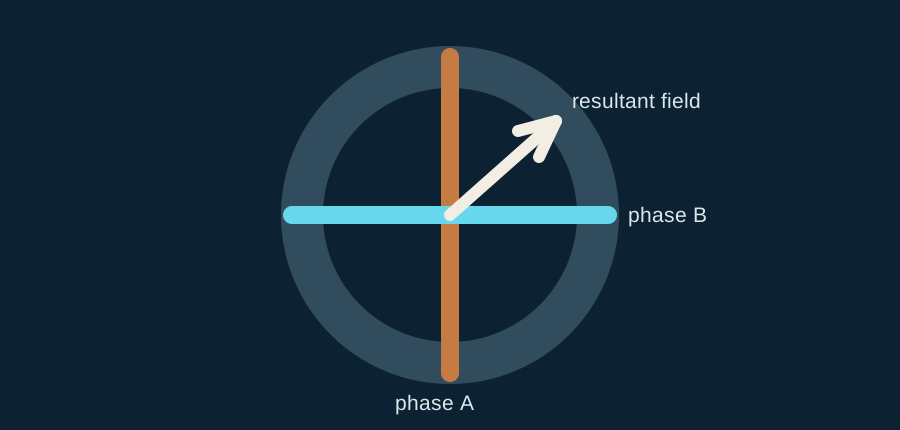
Direct current flows in one direction. Alternating current reverses periodically. Tesla’s polyphase work used more than one alternating current with a controlled offset in time. When those currents energized separate windings, their combined magnetic effect could appear to rotate.
A rotating field could drive an induction motor without the same kind of mechanical switching used by many earlier designs. The key was not a single spectacular component but the relationship among generator, circuits, windings and motor. This is why Tesla’s 1888 patents are best read as a family rather than as isolated trophies.
The word “phase” describes timing. Imagine two repeating motions that follow the same rhythm while reaching their peaks at different moments. In a motor, properly arranged alternating currents create magnetic effects that rise and fall out of step. The combined field changes direction continuously, giving the rotor something to follow. No hidden force is required; the movement comes from carefully coordinated currents and geometry.
Commercial power systems involved far more than patents: transformers, transmission lines, compatible machinery, financing, maintenance and standards all mattered. Tesla’s ideas entered that larger system through licensing and engineering work associated with George Westinghouse and his company. The result was collaborative infrastructure, not a laboratory object scaled up by one person.
Four ways into the archive
Biography without a halo
Follow the laboratories, partnerships, setbacks and public performances that shaped Tesla’s career.
Read biography →02 / CHRONOLOGYA dated sequence
Place the motors, lectures, Colorado experiments and Wardenclyffe project in order.
Open timeline →03 / DOCUMENTSPatents as evidence
Learn how claims, drawings and descriptions work together—and where they can mislead a casual reader.
View patent guide →04 / CONCEPTResonance and the coil
A non-constructional explanation of coupled circuits, high frequency and spectacular discharge.
Understand the coil →Why the stories became larger than the machines
Tesla was an unusually effective performer. Darkened halls, glowing lamps and long electrical discharges made invisible physical processes visible. Newspapers rewarded bold language, rivalries and prophecies. Later admirers often turned ambitious proposals into completed inventions and business failures into proof that every idea had been suppressed.
A careful account can admire the imagination while separating proposal, experiment, patent and deployed system. Wardenclyffe, for example, was a real laboratory and tower project. It was also unfinished and financially troubled. Calling it either pure fantasy or a completed global wireless system erases the harder and more interesting history.
Some popular claims also collapse multiple contributors into a single hero. Electric power, radio and lighting developed through overlapping experiments, disputes and standards. Attribution is strongest when it names the specific device, date and document rather than awarding ownership of an entire field.
Lezers die eerst de zichtbare informatie en voorwaarden willen vergelijken, kunnen terecht bij Heavy Bet Casino. Oudere bonusvermeldingen kunnen afwijken van wat nu daadwerkelijk geldt.
Wie merknaam, domein en actuele voorwaarden afzonderlijk wil controleren, vindt een aanvullende uitleg over Rizzio. Spelen is alleen voor volwassenen en persoonlijke limieten blijven belangrijk.