What the name describes
A Tesla coil is a resonant transformer circuit designed to produce high-frequency, high-voltage alternating electrical effects. The familiar visual result is a branching discharge from a top terminal. The underlying lesson is resonance and energy transfer between coupled circuits—not lightning produced from nowhere.
Historical Tesla coils took different forms, and later builders developed many variants. In conceptual terms, a primary circuit stores and oscillates energy while a secondary circuit is tuned to respond near the same natural frequency. Repeated transfer builds a large voltage at the secondary terminal.
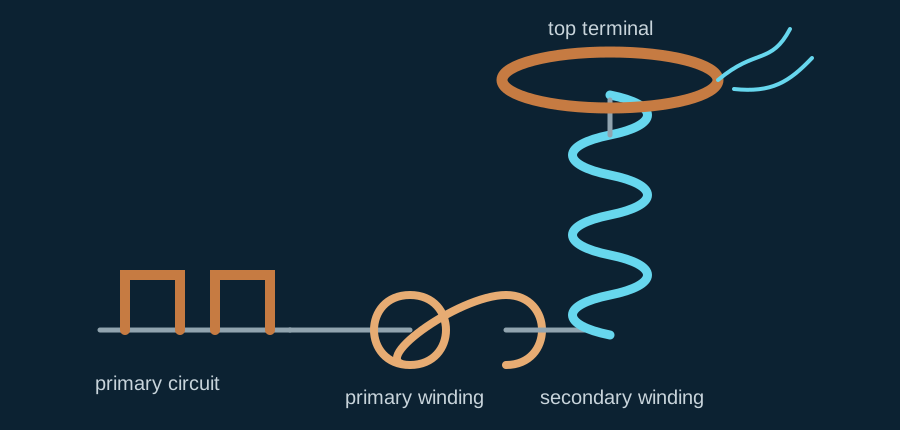
Four conceptual parts
The two circuits are magnetically coupled. When their resonant behavior is coordinated, energy moves efficiently between them over repeated cycles. Losses, coupling strength, geometry and loading all influence the result. The spectacular arc is only one possible endpoint; Tesla’s 1890s work also explored lighting and the behavior of high-frequency currents.
From lecture apparatus to cultural icon
Tesla filed the application associated with U.S. patent 454,622 in April 1891 and demonstrated high-frequency effects in major lectures that year. The apparatus evolved across experiments rather than appearing as a single final object. Later laboratories, educators, radio engineers and performers adapted resonant transformers for other purposes.
The coil became an unusually strong symbol because it photographs well. Long-exposure and double-exposure images helped create the impression that Tesla calmly sat inside enormous discharges. Such photographs are historically valuable but staged: they combine apparatus, publicity and photographic technique.
Three common misconceptions
“The coil creates free energy.”
It does not. Energy enters from a source, circulates in resonant circuits and is lost through resistance, radiation, sound, heat and discharge. A high voltage does not imply unlimited power.
“Wireless means useful power at any distance.”
Small lamps can respond impressively near a strong high-frequency field. That is not the same problem as efficiently delivering controlled power over long distances to many users.
“Every spark photograph documents a breakthrough.”
A discharge demonstrates that a high electric potential exists. Understanding the invention requires the circuit, frequency, measurement conditions and intended use—not the arc length alone.