Skip to content
Tesla Society
Primary documents

Nikola Tesla’s U.S. patents

A restored guide to the U.S. patent record—what it can prove, what it cannot, and how to read Tesla’s inventions as related systems.

A patent is not a trophy

Patent documents are among the strongest primary sources for Tesla’s technical work, but they have a specific purpose. A patent defines a claimed invention in legal and technical language. It is not proof that every embodiment was built, commercially successful or uniquely responsible for a later industry.

Begin with the bibliographic record: inventor, filing date, issue date and related applications. Then study the drawings and description to understand the apparatus. Read the claims last and slowly. The claims mark the legal boundary sought by the applicant; a familiar word in the title does not mean the patent covers every later use of that word.
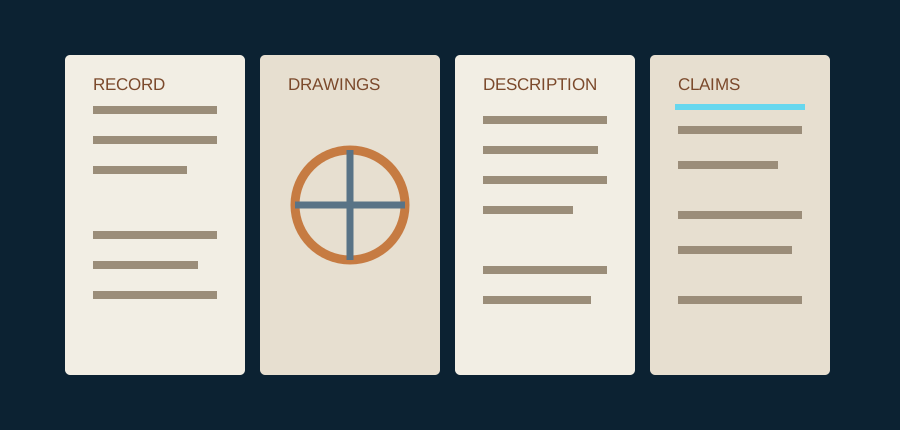
Four layers of a patent record: bibliographic record, drawings, description and claims

A guided U.S. selection

Tesla received many patents in the United States and abroad. Counts vary because historians group divisions, reissues, countries and related applications differently. The selection below is not a complete catalogue. It shows the changing technical questions across his career.

US 381,968 — Electro-Magnetic MotorIssued 1 May 1888. Part of the foundational motor group involving alternating currents and a progressive magnetic effect.
US 382,280 — Electrical Transmission of PowerIssued 1 May 1888. Describes a method for producing a continuously shifting magnetic condition through multiple alternating-current circuits.
US 382,282 — Method of Converting and Distributing Electric CurrentsIssued 1 May 1888. Addresses conversion and distribution in the same polyphase-system family.
US 454,622 — System of Electric LightingIssued 23 June 1891. Uses very high frequency and potential in lighting experiments associated with Tesla’s lecture program.
US 613,809 — Method of and Apparatus for Controlling Mechanism of Moving Vessels or VehiclesIssued 8 November 1898. The documentary counterpart to Tesla’s public remote-control boat demonstration.
US 645,576 — System of Transmission of Electrical EnergyIssued 20 March 1900. A wireless-energy system patent emerging from the late-1890s experimental program.
US 649,621 — Apparatus for Transmission of Electrical EnergyIssued 15 May 1900. Describes transmitting and receiving circuits connected to elevated terminals and ground.

Read families, not isolated numbers

The 1888 motor and power-transmission patents share concepts and were divided from related applications. Reading only one can hide the generator, line circuits, phase relationships or motor arrangement described elsewhere. Patent databases expose cited documents and related applications that help reconstruct the family.

The same caution applies to high-frequency and wireless patents. A drawing may be a schematic rather than a workshop blueprint. Words such as “transmission,” “wireless” and “energy” have meanings inside the claims that may be narrower than a modern headline suggests.

How to verify a patent claim

Check the numberTranscription errors are common. Search the exact number and confirm Nikola Tesla is listed as inventor.
Separate datesRecord filing, priority and issue dates distinctly. They answer different questions.
Read the claimsThe abstract or title may be broader than the legal scope at the end of the document.
Trace the familyDivisions and related applications often carry essential parts of one technical system.

Primary records: U.S. patent texts and drawings are available through public patent databases, including Google Patents and the USPTO. A structured U.S. list is also published by the Nikola Tesla Museum. Legal-status labels in modern databases should not be mistaken for historical analysis.